Training


Read story here: https://igadstvs.wordpress.com/2015/06/11/burao-livestockmarket/

Authors: Mohamed Abdilatif, Muse Awale, Abdirizak Kayd, Ali Kanu, Nahla Abass

IE7A6030

Some of the shades and actors in the market

From far it looks plain and disorderly, but at a closer look and brief interaction with the different actors, the story is different. It is a tale of thousands of people who flock to the livestock market daily to making a living. Being one of the largest livestock markets in the Somali eco-system and probably the largest in Somaliland, Burao livestock market is full of life.

It is an open market that brings together thousands of people daily, from various backgrounds.

The market does not only serve the actors in the value chain, such as producers, traders, middlemen and the tax collectors. It is also a source of livelihood for hundreds of people, which can be referred to as sub actors, they include, dozens of restaurateurs, milk sellers, tea sellers, miraa (khat) sellers, kiosks, animal transporters and loaders etc.

The main market serves goats and sheep trade only, the cattle and camel market is some distance from the main livestock market. Whereas there are no official figures on the daily transactions, it is thought that hundreds of thousands of dollars (can be millions of dollars during the high seasons) change hands daily. In the market two groups of livestock are sold, one group for local consumption and another for export. In that regard the market contributes immensely to the local economy.

In a nutshell, there are so many people who flock to the market for a good reason. Some sell animals, some buy, others buy and resell. It looks so simple from outside, but in reality it is a market that is full of life, every day the market serves thousands of people and the majority of them are not the main actors.

The following is a systematic flow of the market cycle:

IE7A6006

A lady buyer looking at sheep and goats with intention of buying

IE7A6006

The lady buyer checking the body condition of a goat

Animals being loaded to a track, Buro

Shoats being loaded on the truck

IMG_2774

Shoats en route to Berbera after going through the process of buying and selling, branding and loading
Read story here: https://igadstvs.wordpress.com/2015/06/11/using-livestock-manure-to-improve-soil-fertility-offers-ways-to-enhance-forage-snf-fodder-production/

Somaliland Pastoralists face frequent feed shortages for their livestock. This is caused mainly by water scarcity, low soil fertility and the high cost of fodder (due to demands from exporters).

This is a perenial problem and therefore, there is need for long term solution, the use of livestock manure have been shown to increase dry matter in other countries but no studies have undertaken to evaluate the use of livestock by product in Somaliland.

Feed forage is one of the most important factors in livestock production among the Livestock keepers, especially in arid and semi-arid regions. Additionally soil nutrient have depleted over time hence the application of fertilizers and manure . An experiment was carried out under a rain shelter in Malaysia to determine the effects of manure on soil fertility and drip irrigation on forage dry matter content.

The results of the study indicated that total dry matter was higher in livestock manure rather than commercial fertilizer. The highest growth parameters and shoot dry weight were recorded from daily irrigation intervals with goat manure, while the highest yield components were obtained from daily irrigation frequency with NPK fertilizer and poultry manure.

In the light of these results, therefore, for optimum biomass of forage, high irrigation frequency with goat and poultry manure is the most viable option while yield was greatly favoured by a high irrigation frequency with NPK. These findings from research in Malaysia suggest some opportunities for Somaliland to test the hypothesis that the use of livestock manure, with drip irrigation, will lower the costs of livestock feed among livestock keepers offering more sustainable ways for pastoralists to earn their livelihoods.

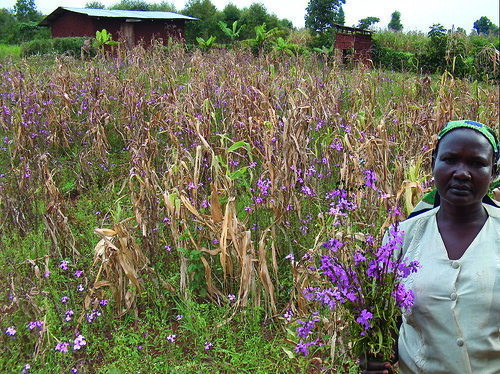
Mrs Ogona

Striga is a nightmare weed for maize farmers in Western Kenya

Addis Ababa, 12 April: The social media training started today. The training took place at ILRI Addis Ababa and it was conducted by IT professionals who are highly skilled in managing social media. They emphasised the need to carefully categorise the content. This is akin to classifying the content for search engines.

The training continues on 13 April starting at 9 am

Social media training for EADD and AATF

Training participants were drawn from AATF based in Nairobi, Kenya and EADD Kenya and Uganda offices. The facilitators are from ILRI Ethiopia.

Areas covered

Day one of the training covered an introduction to social media tools. These include blogs and wikis. Day two will look at twitter and yammer.

WEMA mock trial

Design a site like this with WordPress.com
Get started