Socialmedia


Read story here: https://igadstvs.wordpress.com/2015/06/11/market-prices-in-burao-livestock-market/

Authors: Abdirahman Ismail, Anna Silverstone

The heart of Somali life rests in its livestock. Used for trade, dowries and livelihood, camels, sheep and goats are among our most valued possessions.

Comprising 80% of our GDP and involving almost all of the country either directly or indirectly, it is no exaggeration to say that livestock is as essential to Somaliland as we ourselves.

Exportinging animals from Berbera port
Arriving at Burao Livestock Market around 9:30 on a hot March morning, the team from ISTVS set out to uncover the exact price of livestock in the market as well as the market forces that drive fluctuation. Our targets were the buyers and producers themselves for the first hand information they could provide. Within the Burao market there are five main market players: the producers, the brokers, the small agents, the buyers for local consumption and the buyers for export.
Feed being transported
While we only managed to talk to market brokers and small agents, all were highly forthcoming. According to their experience price fluctuations occur due to demand, supply and season, as well as slightly less obvious factors such as bad roads, weather and being interviewed on the price of their stock. As can be seen from the table below the price of small ruminants can vary by as much as $20 per animal for the export market, the difference becoming even greater when comparing Haj export prices to local consumption.

Livestock market price in Burao on 17th march 2015

Read story here: https://igadstvs.wordpress.com/2015/06/11/using-livestock-manure-to-improve-soil-fertility-offers-ways-to-enhance-forage-snf-fodder-production/

Somaliland Pastoralists face frequent feed shortages for their livestock. This is caused mainly by water scarcity, low soil fertility and the high cost of fodder (due to demands from exporters).

This is a perenial problem and therefore, there is need for long term solution, the use of livestock manure have been shown to increase dry matter in other countries but no studies have undertaken to evaluate the use of livestock by product in Somaliland.

Feed forage is one of the most important factors in livestock production among the Livestock keepers, especially in arid and semi-arid regions. Additionally soil nutrient have depleted over time hence the application of fertilizers and manure . An experiment was carried out under a rain shelter in Malaysia to determine the effects of manure on soil fertility and drip irrigation on forage dry matter content.

The results of the study indicated that total dry matter was higher in livestock manure rather than commercial fertilizer. The highest growth parameters and shoot dry weight were recorded from daily irrigation intervals with goat manure, while the highest yield components were obtained from daily irrigation frequency with NPK fertilizer and poultry manure.

In the light of these results, therefore, for optimum biomass of forage, high irrigation frequency with goat and poultry manure is the most viable option while yield was greatly favoured by a high irrigation frequency with NPK. These findings from research in Malaysia suggest some opportunities for Somaliland to test the hypothesis that the use of livestock manure, with drip irrigation, will lower the costs of livestock feed among livestock keepers offering more sustainable ways for pastoralists to earn their livelihoods.

Mrs Ogona

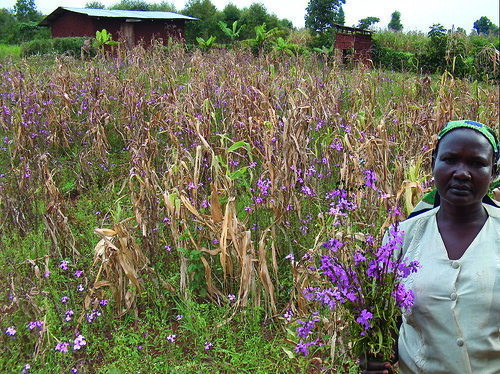
Striga is a nightmare weed for maize farmers in Western Kenya

Addis Ababa, 12 April: The social media training started today. The training took place at ILRI Addis Ababa and it was conducted by IT professionals who are highly skilled in managing social media. They emphasised the need to carefully categorise the content. This is akin to classifying the content for search engines.

The training continues on 13 April starting at 9 am

Social media training for EADD and AATF

Training participants were drawn from AATF based in Nairobi, Kenya and EADD Kenya and Uganda offices. The facilitators are from ILRI Ethiopia.

Areas covered

Day one of the training covered an introduction to social media tools. These include blogs and wikis. Day two will look at twitter and yammer.

WEMA mock trial

Its just my first attempt at blogging and I am already loving this. I can now have my name listed on the Google search engine for writing about something I am very passionate about. I find this truly awesome

ILRI Board of Trustees - April 2011

Design a site like this with WordPress.com
Get started